Tuesday, July 27, 2010

APC Blog Assignment 6 - The History of English


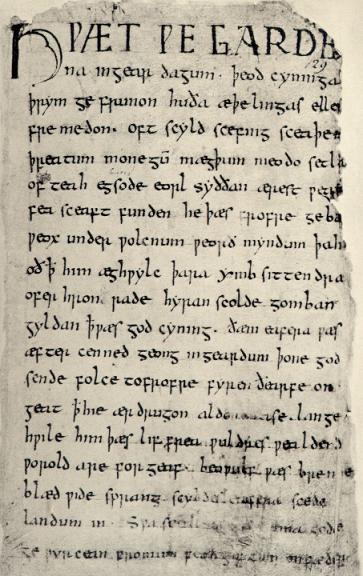
English used to look like this!


The English language has a very long and confusing history. Before English was spoken in England, there were many different languages of the people living there. Eventually, around 450 A.D., Germanic people came to England and the language of Old English was created. Old English is very different from English today- American and British people can't read it! Look at this example:

Hwæt! Wē Gār-Dena in geārdagum,
þēodcyninga, þrym gefrūnon,
ðā æþelingas ellen fremedon.
Oft Scyld Scēfing sceaþena þrēatum,
monegum mǣgþum, meodosetla oftēah,
egsode eorlas. Syððan ǣrest wearð
fēasceaft funden, þæs frōfre gebād,
wēox under wolcnum, weorðmyndum þāh,
oðþæt him ǣghwylc þāra ymbsittendra
ofer hronrāde hȳran scolde,
gomban gyldan. Þæt wæs gōd cyning!
This is from a famous poem called Beowulf, which was written around 900 A.D. The time of Old English ended around 1066 A.D., when the Normans came to England. The Normans were a French speaking people, and there is an area of France called Normandy where they are from. This is what started Middle English, which started to add many French and Latin words, and the grammar became simpler. Here's an example of Middle English:

Whan that Aprille with his shoures soote
The droghte of March hath perced to the roote
And bathed every veyne in swich licour,
Of which vertu engendred is the flour;
Whan Zephirus eek with his sweete breeth
Inspired hath in every holt and heeth
The tendre croppes, and the yonge sonne
Hath in the Ram his halfe cours yronne,
And smale foweles maken melodye,
That slepen al the nyght with open yë
(So priketh hem Nature in hir corages);
Than longen folk to goon on pilgrimages

That is from The Canterbury Tales, written in the 1300s, A.D., by Geoffrey Chaucer. It is a very famous book. I can understand most of it, but the spelling is very different. Some of the words are very close to German and Dutch words, too. Middle English ended in the 1400s, when Modern English was created. Printing and adding lots of words from other languages helped create Modern English. Shakespeare was one of the first famous writers of Modern English, and English speakers today can understand his work.

Even though English got many of its words from Germanic languages, French, and Latin, it has also received many words from Arabic. The Arab world has a long history with Europe, so many words were shared. Look at this list of Arabic words that came to English:

http://en.wikipedia.org/wiki/List_of_Arabic_loanwords_in_English

Notice that some of the sounds or spellings seem different. This happens a lot when words are shared between languages.


Choose 3 words from the list that are interesting to you, and tell me why you think they are interesting. Then, make a new English word using an Arabic word, and give the definition. Be creative!

APC Journal #9: July 27, 2009

1. This is the last journal topic of the summer. Write about your learning experience this summer, and talk about your goals for next semester.

2. Write a paragraph about your daily life.

Monday, July 26, 2010

APC Blog Assignment 5 - Counterfeit Products


Counterfeit products
make millions, maybe billions, of dollars every year. A product is an item made by a company, but counterfeit products are not made by the real company. They are fake items that are made illegally.

However, the people who make counterfeit products are very good at it! They use advanced technology, like scanners, computers, and professional equipment to make the fake items. Because of that, it can be very difficult to know if something is counterfeit or real. There are some general tips, though:

1. Think about the price. If something is too cheap, it might not be real. For example, a real Coach purse will not sell for 35 bucks.

2. Look at where the item is. Real products are sold in legal stores. Counterfeit products might be sold on the street. For example, real iPods are not legally sold on the street.

3. Try to notice very small flaws (mistakes) in the designs. Sometimes, a designer name can be spelled differently. For xample, if a shirt says "Georgio Armani" instead of "Giorgio Armani", it is a fake!

Do you think you can decide if a product is real or fake? Take this quiz:

http://www.walletpop.com/quizzes/spot-the-fake-product


Take the quiz and tell me your score. Then, tell me which product was the most difficult. Why was it difficult to tell if it was real or counterfeit?

APC Jounral #8: July 26, 2010

1. You have taken many tests at PIE. Which parts are easy? Which parts are difficult? How can you do better on future tests?

2. Write a paragraph about your daily life. Maybe you could write about the weather today! Remember, we've learned words like lightning and thunder.

Thursday, July 22, 2010

APC Journal #7: July 22, 2010

1. Have you ever seen or bought fake (counterfeit) things? Tell about what it was, where you saw it, and when you saw it.


2. Write a paragraph about your daily life. Remember, you can just write about a movie you watched, or an activity you did, or anything else you want to write about.

Tuesday, July 20, 2010

APC Blog Assignment 4 - Webcomics


What is a webcomic? Well, it comes from two words: web ("world-wide web," which is the internet) and comic (a story told with drawings).

Webcomics are comics that can be found on the internet. Unlike normal comics, you can't hold a webcomic: you read them on your computer monitor. As the internet has spread, so have webcomics. Some are very popular!

Making webcomics can even be a career. Most webcomics are made as a hobby, but the best ones can make enough money to be a full-time job. Creators of webcomics are very independent; they make the comics all by themselves.

The best thing about webcomics is that they are free! Creators get money from ads on their websites, and selling items like t-shirts. You should try reading some webcomics- they have fun stories and are a relaxing way to practice reading. Try one of these links:

http://axecop.com/
http://pajamaforest.com/

You can also find comics from newspapers on the internet. Try this site:
http://comics.com/


This blog assignment is easy- just find a webcomic, read it, and tell me about it. I hope you find something you like!

APC Journal #6: July 20, 2010

1. If you had 1,000,000 dollars, what would you do?

2. Write a paragraph about your daily life.

Monday, July 19, 2010

APC Journal #5: July 19, 2010

1. Write about your favorite book. Tell about the story and characters, or whatever it is about.

2. Write a paragraph about your daily life. Remember, you can write about movies or TV you saw, things you did, etc.

Friday, July 16, 2010

APC Blog Assignment 3 - Smartphones

How can a phone be smart? It's only a machine!


Nevertheless, "smartphones" are one of the best-selling items on the market. Even though they are not "smart" like people are, they can do lots of very useful things. You can check your email, call friends around the world with Skype, play games, and even watch YouTube videos. Millions of people own smart phones.

There are many different companies that make smartphones. Apple is probably the most famous. Their iPhone is a best-seller for the company, and their AppStore (where users can buy applications for their phones) makes lots of money. But there are competitors: HTC, Samsung, Motorola, LG, BlackBerry, and others. Many of these companies make phones that use programs by Google. You might say that there is a battle between Google and Apple programs for smartphones!

Even though smartphones are very popular these days, not everyone wants one. Some people prefer simpler phones- they like e-mailing and watching videos on their computers, not their phones. Also, smartphones are expensive: a new phone costs hundreds of dollars, and the monthly phone bill is also much more expensive than a normal phone.

How do you feel about smartphones? Do you have one? Do you want one? Tell me about your ideal phone. To find more information about cell phones, try this website: http://reviews.cnet.com/cell-phones/

APC Jounral #4: July 15, 2010

1. Do you prefer living in a big city or a small city? Tell why.

2. Write about something in your daily life.

Tuesday, July 13, 2010

APC Journal #3: July 13, 2010

1. You have been away from home for over 1 month now. Write a paragraph about what you miss the most. Give reasons and details.

2. Write about your daily life. Remember, you can write about a movie you saw, something you did, or things like that.